

I've Been Running From Heartbreak My Entire Life
A stranger assumed a man broke me. I let him believe it. The truth is more complicated.

By evening, the guy from the hot springs, the beer, the “you looked peaceful,” was in my trailer eating noodles.
That afternoon, I’d learned to float. By evening, I was learning something else: how old patterns wake up in small spaces.
Just me, my friend who invited me here, and him. Cooking ramen like teenagers when their parents are out of town. The kind of spontaneous intimacy that happens when you’re living in temporary proximity at a place like Fly Ranch.
Except I could feel it starting. The noticing. The hyperawareness. The old instinct to become whatever shape might get me the outcome I needed.
I came here for vision. For clarity about the sanctuary I was building back home. I wasn’t expecting excavation. I wasn’t expecting him to trigger the exact patterns I thought I’d already worked through.
I’ve been running from heartbreak my entire life, so afraid to get close to anyone or anything because I never wanted to feel it again. Somewhere along the way I learned to keep people entangled just enough so they couldn’t leave while staying shut off just enough so they could never get too close. I’m so terrified of being alone that I’ve made loneliness into architecture, building walls that look like intimacy from the outside but feel like prison from within.
But the heartbreak I’ve been running from isn’t the one he’ll assume. It never is.
That evening, back at the hot springs, he asked me a question that gave me goosebumps despite water hot enough to dissolve us both.
And I let him believe what I needed him to. Because sometimes the only way to figure out the truth is to watch yourself perform the lie.
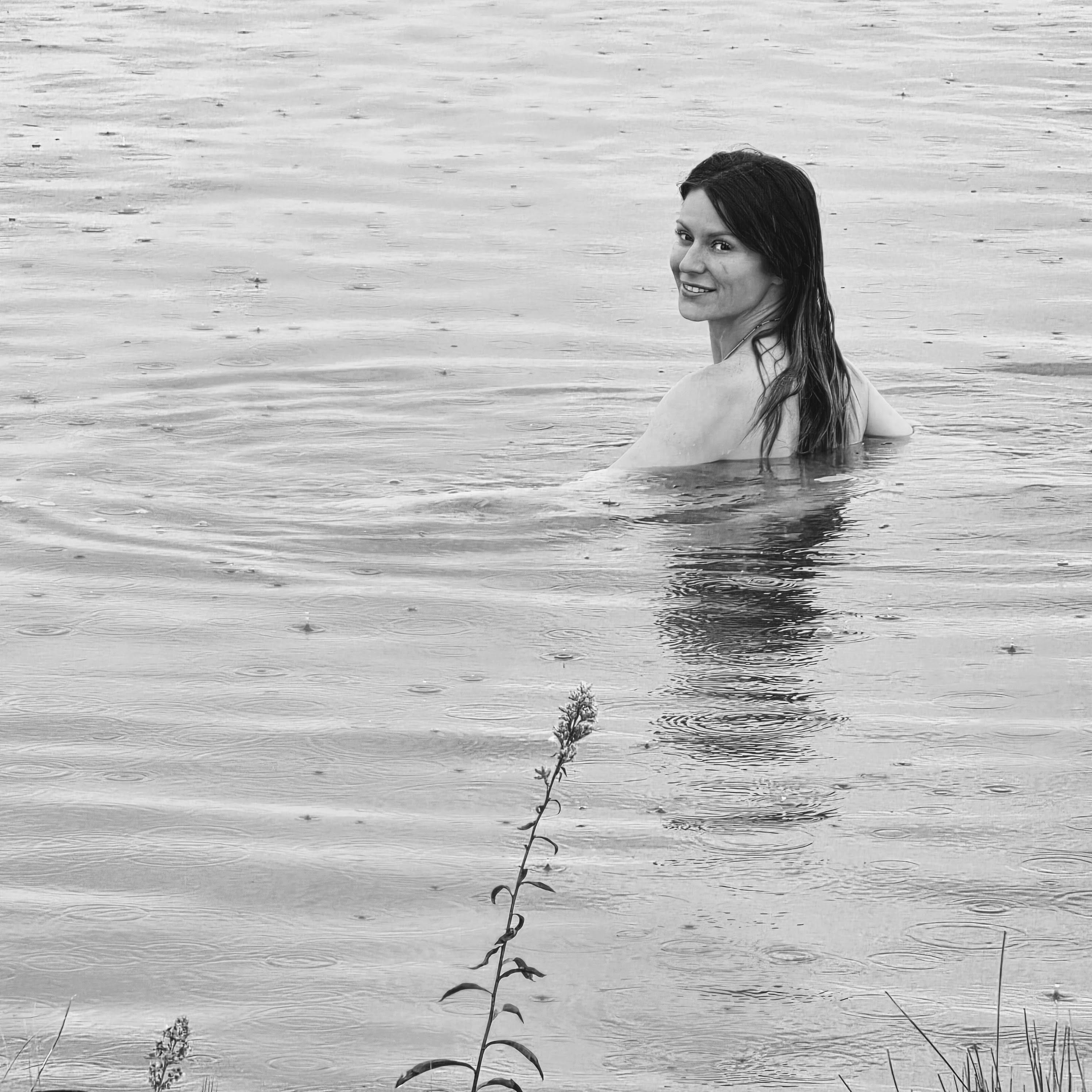
I could feel him through the current underneath, every shift in his body sending a ripple over me that made me absorb every detail about the moment. It’s probably a trauma response, but I like to think of it as a superpower that has saved me more times than not. It’s also nearly killed me.
The air above the water was cool and misty, sprinkling my face while steam rose between us like we were inside something unreal, a dreamscape where truth might finally be possible.
He asked what I did, and I paused, considering how to introduce myself. This is the first taste of me someone gets, and I’ve been so many things, worn so many hats and uniforms that sometimes it’s difficult to know where to start.
So I said the thing I always dreamed of being, as if declaring it aloud would make it true.
“A writer,” I said.
I couldn’t tell how interested he was when he asked what my book is about.
I said, “My life.” I paused, contemplating how to say the most in the fewest words. I could have just said the name of this Substack, the name of my body of work: How the fuck did I get here? It sums up the point. I’m always in some precarious or slightly unbelievable scenario, so I’ve been told, so it’s a title to pique universal interest. The story is a wild ride from the beginning, and the brakes have yet to pump. Only somehow, I’m now not afraid of crashing. I’m coasting, but in control. I’m looking out the window at the mountain pass, I’m tuning the radio, and I’ve got time to think.
But what is it I’m always contemplating?
“Heartbreak,” I said, raw and immediate, trying to claim the story I’ve been writing my entire life.
He stared at me, the steam framing his face, and I recognized something familiar in him. Not him specifically, but the archetype. Another version of someone who would have once been amused by one of my stories. Someone safe enough to perform for. Someone I could make believe anything.
“How many heartbreaks have you had?” he asked, his voice landing somewhere between genuine curiosity and the kind of question you ask when you’re supposed to.
There wasn’t time for a reply before the answer was out. “One.”
The word hung in the steam between us.
He studied me, and I felt my fawn response take over like a familiar drug. That instinct to become whatever shape would get me the outcome I needed. Understanding, maybe. Or just someone to witness that the pain was real, even if they couldn’t know what it actually was.
“He must have really fucked you up,” he said, his voice dropping into something almost tender.
My chest tightened on his assumption of my entire narrative. The heat of the water pressed against my ribs but I felt cold inside, like something essential had just been stolen. My jaw clenched before I could stop it, and I dropped my mouth into the water, trying to control an old habit of mine to notice everything about a boy. The way the water beaded on his brow. The way his eyes crinkled when he smiled with a closed mouth. The way he made you feel like he was reading something you weren’t ready to reveal.
He didn’t know anything about me. He didn’t know who or what I was referring to.
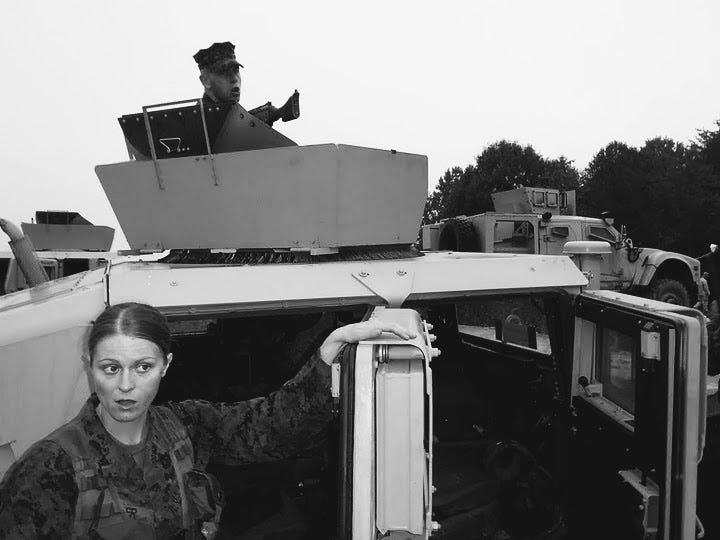
Not that I’d been married since I was twenty years old, caught in a trap between being a slut or a bitch in the Marine Corps that called me both anyway. That I thought a ring would protect me but instead it became the thing that made it impossible for me to ever talk about what came before the vows.
Not that having two daughters cracked open the worst parts of me that never got to grow up, and that despite it all, I still house my mother without resentment for the home she could never build for me.
Not that my heartbreak ripped open an abandonment wound rooted so deep, I’d have to go all the way back to the very beginning to make sense of it all, a wound conditioned, making every subsequent loss feel like the first one all over again.
Not that my origin story begins with a mother and daughter escaping the jaws of a demon. A literal cultist. A man who was psychologically manipulative in ways I didn’t have words for yet.
And how when she met a boy who made her feel not so alone, she forgot how to identify love from pain. Everything was sacred after that. Everything became documented.
Not that I write about the nuance between fate and choice, about how I chose safety over authenticity so many times I drowned in my own lies.
But he could assume the scars a man left behind. Perhaps because he’d been one of those men before with a woman like me.
The irony, my rational mind pointed out, was that I wasn’t even talking about Him.
For the first time, I was finally talking about me. That was supposed to mean something.
But looking at this stranger, my triggered mind projected an intimacy that didn’t exist, seeking the familiarity of a conversation I’d never been allowed to have. And suddenly I wasn’t sure anymore. Because all of it is the same heartbreak that I write about.
I wanted to tell him how I was writing the story in that moment, preparing to find a way to go to my subconscious mind without falling into the depths of it. I wanted to tell him how much I struggle with not filtering myself for someone else’s comfort.
I wanted to tell him that somewhere I still don’t have closure, and that’s my greatest secret of all. This is the one thing holding me back from moving past this. That the silence of truth, the ghosting of your past, is the abuse. That I’ve been writing on and off for years, undergone several rewrites, still realizing I’m not telling it correctly for it to actually make sense because I’m still avoiding the main plot.
I wanted to tell him: How am I supposed to tell that story if I don’t tell the whole thing?
But I didn’t. I was trying something different.
I let him believe what I needed him to. Because in that moment, I was figuring out how I wanted to tell the truth of how I am both the heartbreaker and the heartbroken. That what looked like willful abandonment was just me not knowing any other way to survive. That I’m learning how to tell the truth, even to myself.
My mouth burned as I recognized the familiar panic, the same toxic cycle. The same performance to extract a specific narrative I’m trying to rewrite. The same script I’ve been reading from since I was too young to write my own lines.
I’d been here so many times, but this time it settled into something unexpectedly different. A clarity that I was in control. That I wake up now in a home where I finally trust that I am safe. Where I’m not afraid to say the things I hadn’t said before.
He shifted in the water. I became suddenly aware of other voices in the background, the clear water exposing our naked skin, how I floated there, heavy with what I carried, but not being pulled down by it. This wasn’t the same. I had changed. I had grown up.
I felt certain I was about to learn something about myself I didn’t yet know how to heal.
This is the first chapter where I try to say it out loud: I’m here, in the hot water, learning how to stay.
What I didn’t expect is what would happen when I went home and found out that being raw with a stranger would turn out to be easier than being honest with the person who knows me best.
Continue the Story
I left Fly Ranch believing I’d finally figured it out. That I could be raw, unguarded, authentic.
What I learned when I got home: being vulnerable with strangers is practice. Being vulnerable with the person who knows you best is the actual work.
The Intimacy Paradox

My husband and I stared at the spaceship-looking white dome that now stood in bright contrast against the hundred-year-old redwoods, the old and natural meeting the new and crafted co-existing. We’d finally done it.
Read What Came Before
These essays aren’t written in order. They’re written when the story demands it, when the memory surfaces, when something finally makes sense that didn’t before.
If you want to understand what Fly Ranch was teaching me (about floating, about letting go, about bodies that know how to surface even when we think we’re drowning), start here:

Then read what happened when the water held what words couldn’t:

The pattern: In August, the cursor stayed at chapter one. By October, the body wrote what the mind couldn’t. Not every story needs words to be told.
About This Series
How the Fuck Did I Get Here? is a memoir-in-progress told through interconnected chapters. Each piece stands alone, but together they trace a journey from numbness to presence, from survival to integration, from choosing between two halves to learning to be whole.
This isn’t a story about healing being linear or easy. It’s about what happens when you finally stop running from yourself and ask the hard questions. When you sit with the uncomfortable answers. When you realize that breaking generational cycles means learning to hold both strength and softness at once.
This is the heroine’s journey told in real time: the messy middle, the ongoing practice, the moment-by-moment choice to stay present even when everything in you wants to run.
How to Read This Series
This is a choose-your-own-adventure memoir. Throughout each chapter, you’ll see key words and phrases underlined as hyperlinks. Click them to discover other stories exploring the same themes. Or browse the tags below to find what calls to you.
This interconnected web lets you:
Follow specific themes across the series
Discover related chapters organically
Navigate by what resonates with you
See patterns and connections emerge
Start anywhere. Follow the threads that call to you. Each chapter stands alone, but together they reveal the larger story.
Explore By Theme
This chapter touches:
The Journey
The Origin Story | Finding Freedom | Breaking Cycles | Closure
The Relationships
Heartbreak | The First Love | Marriage as Protection | Intimacy | Strangers
The Struggles
Fear of Abandonment | Avoidant Attachment | Fawn Response | Ghosts
The Work
Being Witnessed | Inner Child Healing | Authenticity | Writing Process
The Places
Click any theme to explore related stories.
About the Author
Alisa Sieber is a writer, former Marine Corps pilot, and mother exploring the intersections of healing, motherhood, and breaking generational cycles. Through raw, embodied storytelling, she examines what it takes to move from armor to integration, from choosing between strength and softness to learning to embody both.
She writes openly about complex trauma, postpartum depression, military identity, and the ongoing practice of staying present. Her therapy is her writing: public, accountable, and in real time.
She lives on a small farm in Northern California with her husband, two daughters, and too many animals. She’s building Chez Serendip, a cultural sanctuary and intentional community space centered on movement, creativity, and transformation.
Share How the Fuck Did I Get Here?
How the Fuck Did I Get Here? is a personal essay series exploring generational trauma, healing, and self-transformation. Through raw storytelling and deep introspection, it unearths the past to understand the present: reckoning with the cycles we inherit and the courage it takes to integrate what the world tells us to split.
If this piece resonated with you, share it with someone who needs to know they’re not alone.
Subscribe to How the Fuck Did I Get Here?
New chapters published weekly. Subscribe to follow this journey of breaking cycles, staying present, and learning what integration actually means: not perfection, but practice.
Free subscribers get:
Select chapters from the archives
Access to select new chapters for 2 weeks
Newsletter in your inbox
Comment access
Paid subscribers get:
Full archives
Access to all new chapters
Unlimited commenting to process alongside others
Gift subscriptions to share with people who need to see if this resonates
My gratitude for supporting this work
Connect with Alisa
Instagram: @alisa.sieber
Youtube: @alisa.sieber
Join the Conversation
Real talk: This shit is hard.
Breaking cycles. Staying present when it’s unbearable. Learning to hold anger and love simultaneously. Some days it works. Some days it doesn’t. Most days, somewhere in between.
If you’re doing this work too (asking the uncomfortable questions, sitting with what doesn’t resolve, practicing integration even when every instinct says run), join the subscriber chat. That’s where we process between posts, share what we’re learning, and stay present together.

And leave a comment below. Not to perform insight or prove you’ve healed. Just to be witnessed. To witness others. To let the messy middle be exactly what it is.
Healing isn’t linear. Let’s stop pretending it is.
You’re not alone in this. Your presence here reminds me I’m not either.
I was sitting with a friend at a memorial for our other friend's wife. Shawn had been my best friend from fourth through eighth grade. As he sat nursing his third gin and tonic, I wondered out loud how it was that I was the one who lost his mind when we all started drinking and smoking weed at approximately the same age.
Shawn looked up in amused bewilderment and said, "I think you forgot what your home life was like when we were kids."
It was the greatest writing prompt I had ever received, one which allowed me to dig a little deeper into the darkness, the places I had avoided for the first fifteen years of my sobriety. I realized I needed to show my mother and father as more than mere villains; I was no longer writing my own version of the perfect "victim's manifesto."
Each and every person has a backstory that might be more than the echo of the generations that preceded it; it's when we awaken that we exert deliberate intention to what remains of the narrative.